Posts

Istanbul's 'GOOD' side

Image
Fascinating, frenetic, and often frustrating, Istanbul can sometimes seem like it’s defined by its unmet potential. With its young population and incredibly rich history, Istanbul should be a hotbed of innovation, but is unfortunately hampered by a lack of diversity, a vast wealth gap, and a political system that limits civic participation—as was plain to see during this past summer’s mass protests...  The quarterly magazine GOOD reached out this past fall to get my take on Istanbul for its " GOOD City Index ," a new feature highlighting "the cities that are emerging, the ones that are figuring out their growing pains or flourishing under the radar." The final piece, published in GOOD 's Winter 2013 issue under the headline "Celebrating Possibility," shines the spotlight on 20 up-and-coming cities, from Accra to Wellington. My writeup on Istanbul appears at number 7 on the index (n.b. I asked for the Bosphorus to be correctly identified as a ...

In the Migrant Kitchen

Image
Sara moves around the large kitchen with laser-like focus, filling a tea glass of water to add to a heaping pot of saffron rice with one hand while sautéing a pan of tart, red dried berries, walnuts, raisins and slivered almonds with the other. The resulting dish, zereshk polow (barberry rice), is a Zereshk polow in progress. popular one in Sara’s home country of Iran, but not so easy to make in neighboring Turkey, where she is living as a refugee... When the International Organization for Migration’s Turkey office and the food website Culinary Backstreets first organized their "Migrant Kitchen" events last year, the rare chance to eat authentic Ethiopian, Filipino, and other foreign cuisines in Istanbul brought variety-starved expat foodies (myself included) out in droves. This year, I got the chance to peek into the kitchen while Sara, an Iranian refugee, cooked up a traditional feast, and to talk to her about her family's struggles in Turkey and the role ...

Istanbul: an introduction

Image
Earlier this year, Time Out headquarters in London asked the editors of all local editions to prepare an "ultra-useful" mini-guide to their city -- its art, nightlife, restaurants, and sights, along with hot tips and fascinating bits of trivia -- that could be used by any of the company's 60 offshoots around the world. The project editor praised my guide to Istanbul as "fantastic. A gorgeous piece of writing – far and away the best one I've had back so far!" Following my departure from the magazine, Time Out Istanbul published the piece this month as " Istanbul in short ." Have a read and discover what has made Istanbul, despite its many faults, a conqueror of visitors' hearts for hundreds of years and counting. UPDATE: Time Out Dubai published a shorter version of my city-guide in December under the title " Why you must go to Istanbul ."

A journey down the Tigris

Image
Fifty years ago, wooden rafts called keleks regularly plied the Tigris River, carrying people, livestock, and cargo – with loads up to 35 tons – from southern Turkey to northern Iraq. Built from logs lashed together and made buoyant by inflated goat skins, a fully loaded kelek could travel the 250-mile distance from Diyarbakır, Turkey, to Mosul, Iraq, in just six days. Today, the rafts' long, heavy wooden oars push slowly through the brown, flat waters of the Tigris as they traverse northern Iraq. Sometimes their bottoms scrape the riverbed, the water levels low enough on a late September day for a tall man to stand waist-deep in the middle of the river. It takes a full day of hard effort to row eight miles. Nice spot for note-taking. Photo by Anna Bachmann . When a last-minute invitation arrived last month to join the environmental group Nature Iraq as they paddled, floated, rowed, and (sometimes) towed a trio of traditional boats down the Tigris River from Hasank...

Art and the city

Image
Every other autumn is eagerly awaited by art-lovers in Istanbul, as it brings (in the odd-numbered years) the return of the Istanbul Biennial . Now in its 13th edition, the biennial itself varies in the quality of its offerings, but reliably brings with it a host of other art exhibitions and events throughout the city -- as well as the opportunity to peek into some typically shuttered buildings, from historic Greek schools to crumbling hamams. This year's biennial curator chose to focus on the public domain , a decision that both dovetailed with and was made problematic by the Gezi Park protests that broke out this summer, increasing both the anticipation and controversy around the international art event. As editor at Time Out Istanbul , I spearheaded this year's coverage of the Istanbul Biennial, putting together a cover package that previewed the event, looked at parallel exhibitions being organized around town, and delved into some of the local artist residency pro...

A little time at the helm of Time Out

Image
I've just wrapped up a seven-month stint editing Time Out Istanbul , the local edition of the popular international line of arts and entertainment magazines. I spent nine years in the United States as an editor at Sierra , the magazine of the Sierra Club, and this brief return to my roots reminded me of how much I enjoy working with writers and conceptualizing packages -- or entire issue's worth -- of stories that will work together to provide a rich experience for the reader. As the head of a very small team, I also did my fair share of writing at Time Out Istanbul . In addition to our Gezi Park protest coverage in the July issue, and our Istanbul Biennial preview in the forthcoming September issue, these are some of the stories I most enjoyed researching and writing: “ Hidden History ” A stroll through Istanbul’s Byzantine past with Context Travel “ Resisting Nostalgia ” An interview with Turkish artist Ali Kazma on his fascination with transformation “ Literatu...

Amid strife, Turks break fast together for Ramadan

Image
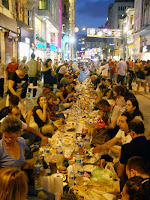
On the first night of Ramadan last month, thousands of people gathered on İstiklal Caddesi in central Istanbul. They laid down newspapers and tablecloths in a long line stretching nearly half a kilometer — then sat down on the ground to break their fast in the middle of the city’s busiest pedestrian boulevard. Passing food and drinks from hand to hand, participants called out to people walking by, “Is anyone hungry? Is anyone thirsty?” and leaped up to distribute water, dates, baklava and other traditional fast-breaking items. As the meal wrapped up, young men toting large garbage bags chanted, “Trash! Trash! Trash!” as they worked their way through the crowd collecting refuse. Ramadan, the month when observant Muslims traditionally fast from dawn till dusk, ended this year on August 7, but not before coming against a backdrop of weeks of street protests in Istanbul and elsewhere in Turkey. The very iftar meal that breaks the day’s fast became a forum for Turkish people to e...