Posts

Cities of possibility
Image
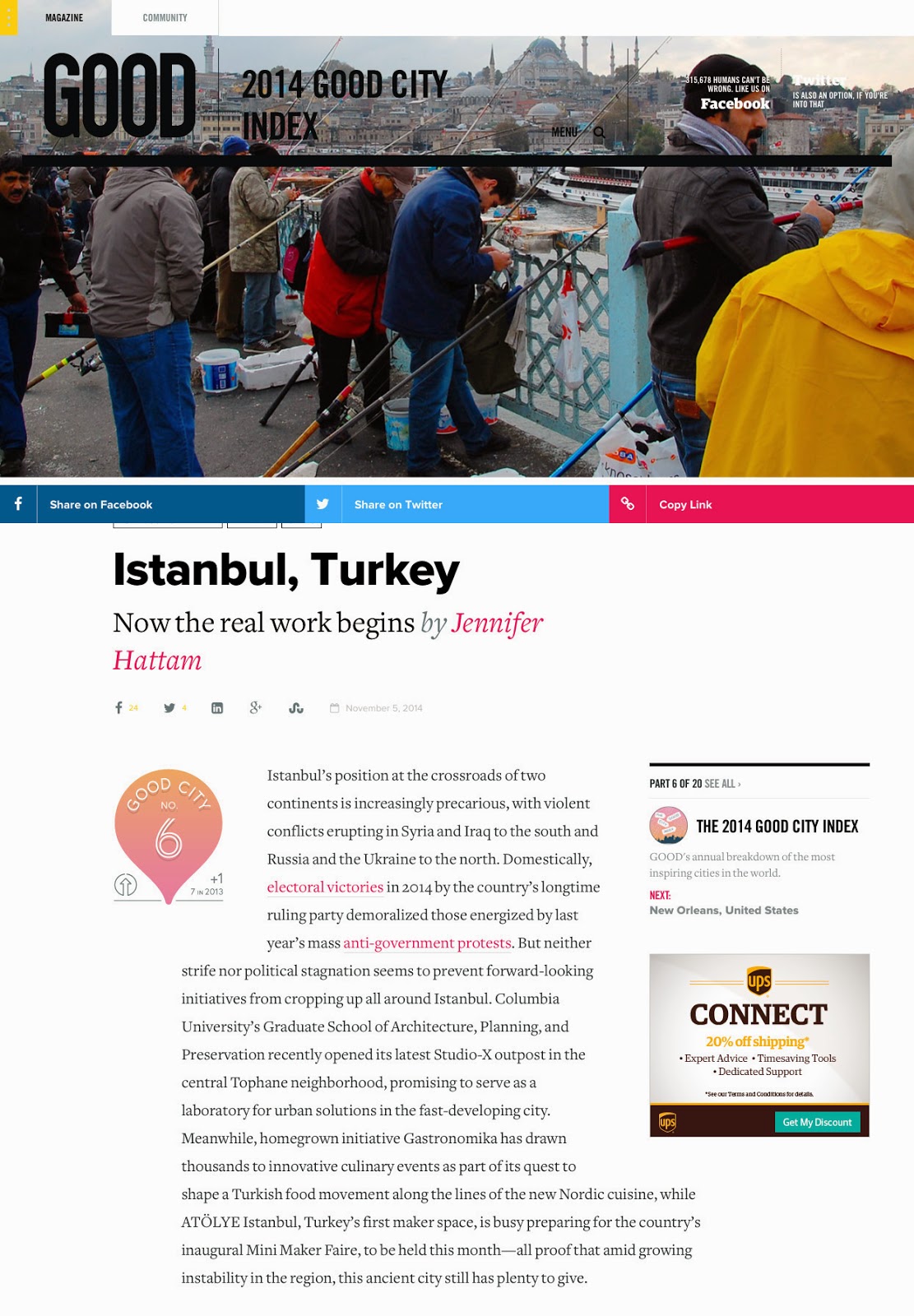
Istanbul’s position at the crossroads of two continents is looking like an increasingly precarious perch these days, with violent conflicts erupting in Syria and Iraq to the south and Russia and Ukraine to the north. Domestically, electoral victories in 2014 by the country’s longtime ruling party demoralized those energized by last year’s mass anti-government protests. But neither strife nor political stagnation seems to prevent forward-looking initiatives from cropping up all around Istanbul... Amid challenging and often depressing times, it was revitalizing to seek out some positive, inspiring initiatives for the 2014 GOOD City Index . As it did with last year's inaugural list , the quarterly, U.S.-based magazine GOOD  again seeks to celebrate the "cities around the world that best capture the elusive quality of possibility" -- not the ones where everything is necessarily working right, but ones with a heartbeat of "creativity, hustle, and civic engagement....

Fishy business in Istanbul

Image
Back in the 1950s, it wasn’t unusual for fishermen plying the waters off Istanbul to land tuna weighing hundreds of pounds, or to have one of the massive fish leap out of the sea and over the prow of their boat. Dolphins cavorted alongside fishing vessels that hauled in lobster, oysters, razor clams, four kinds of crab and eight varieties of mussels. “Fishermen in their 70s and 80s tell stories depicting Istanbul like an island in the middle of the ocean. It’s as if we’ve moved to a totally different place since then,” says Defne Koryürek, the founder of Slow Food Istanbul, which has organized an annual holiday to draw attention to the city’s rapidly depleting waterways and to try and reverse the tide. Celebrated each October with fishing competitions, film screenings, children’s art activities, talks, and special meals, the holiday is named after one of Istanbul’s favorite fish, the fatty, flavorful — but now endangered — lüfer (bluefish)... I've been following the issue...

Seeds of hope for Istanbul's urban agriculture?

Image
Farm-fresh food for sale in Gümüşdere Looking out across today's concrete-covered expanses, it's hard to imagine that Istanbul was once a city of gardens -- and not all that long ago, either. In Ottoman times, according to researcher Aleksandar Sopov, there were bostan (market gardens) all along the ridge passing through Istanbul's old city, many associated with that area's large mosques, and fed by water from the Valens Aqueduct . As recently as 1900, Istanbul was home to more than 1,200 bostan covering as many as 12 square kilometers. Highly productive and tended with sustainable techniques passed down through generations, many of these gardens continued providing food for the local population until mass urbanization kicked off in the 1960s and 1970s. The Tarlataban garden at Boğaziçi University These days, only a scant few bostan remain in the city. The extensive gardens at the base of the old city walls are under threat from development, as I wro...

Garden party

Image
With the world's largest collection of living plants, and its scientists working around the globe to preserve biodiversity, the Kew Royal Botanic Gardens in London is internationally renowned for its conservation work. Less well known, perhaps, is the fact that its 300-acre grounds harbor the ingredients for some darn good cocktails... While visiting London earlier this summer, I ventured out to the Kew Gardens with a journalist friend from the International New York Times  to partake in an impossible-to-resist combination: fancy cocktails, fresh air, and a fantastic setting. As we sipped on Kew-cumbers, Rose Gardens, Gooseberry & Fennels, and Strawberry Cups -- all gin-based drinks concocted from fresh botanicals and seasonal fruits that grow in Kew Gardens -- we chatted with Gin Garden founder Jo Farish about her enviable job creating plant-based pop-up bars at all kinds of interesting places in and around London. Read my article  for Zester Daily ,  " Cocktai...

Bringing the art world to Istanbul

Image
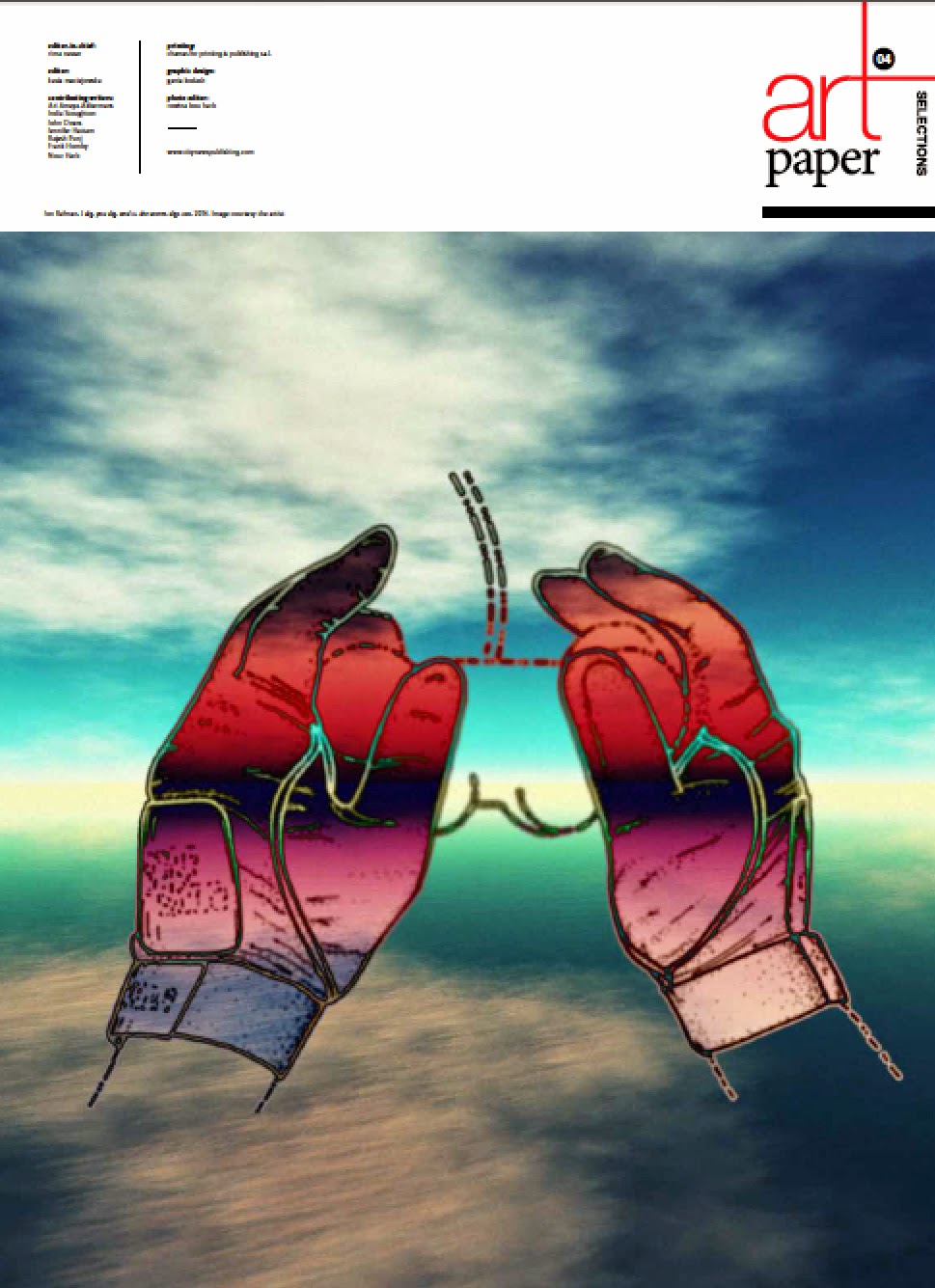
Eighty modern and contemporary art galleries hailing from Helsinki to Hong Kong are set to join ArtInternational for its return to the banks of Istanbul’s Golden Horn in the fall. This year, the fair will bring with it a fresh focus on collecting practices and on experimental film and video art. The inaugural edition last September of ArtInternational, brought to Istanbul by Art HK co-founder Sandy Angus, netted an estimated 21 million euros in sales for its participating galleries. “It’s a truly international art fair with high-quality works, coherence and a good ratio between Turkish and international galleries. That differentiates it from other fairs in Turkey and the region,” says Istanbul collector Tansa Ekşioğlu... Read the rest of my preview of ArtInternational, which will be held held 26-28 September at Istanbul's Haliç Congress Center, in the Fall 2014 issue of Selections magazine's  Art Paper supplement: " Bringing the World to Istanbul...

A sweet but fading tradition

Image
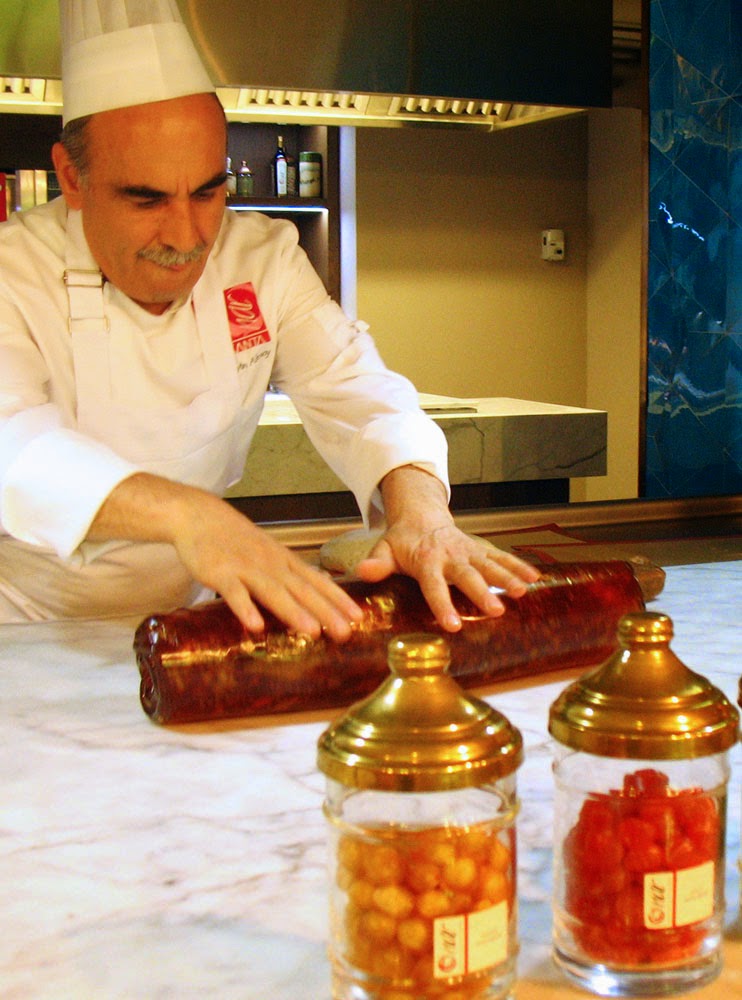
The Altan Şekerleme candy shop was a frequent and favorite stop during my time as a  tour guide  for  Istanbul Eats ’  culinary walks, but what happened in the candy-making operation upstairs was always a closely guarded secret. At a recent press event at the  Istanbul Culinary Arts Center , however, I finally had the chance to  see  how those glistening hard candies were made, and to return for a chat with one of the master  şekerci  (confectioners) carrying on a tradition that dates back, with little change, to Ottoman times: Inside a weathered storefront surrounded by hardware shops, colorful gems gleam in the dim light — large jars full of hard candies flavored with sesame, cinnamon, rose, orange, bergamot and lemon. Candy-maker Hüseyin Aksoy at work Proprietor Hakan Altanoğlu and his forefathers have been making and selling the Turkish candy called akide şekeri at this shop in Istanbul’s Fatih district since 1865, b...

A Turkish artist 'Through the Looking Glass'

Image
Initially ignored and dismissed for her experimental approach, Füsun Onur has become recognised as one of Turkey’s most influential contemporary artists by steadfastly continuing to follow her own path. She has described her art as "musical work without sound," explaining, "I am taking everyday objects and using them as notes." Born in 1938, Onur got her undergraduate degree at what is now the Mimar Sinan University of Fine Arts in Istanbul, where she studied with Ali Hadi Bara. The Iranian-born sculptor was influential in moving Turkish sculpture away from official monuments and into more abstract realms. Onur made her own mark by pioneering installation art that pushes the boundaries of both sculpture and painting, incorporating everyday objects and aspects of daily life but taking them out of their normal context in a way that prompts the viewer to reassess the meanings typically attributed to them.. . Read the rest of my preview of "Füsun Onur: Thro...